

Have you ever noticed how a home run so smoothly that you rarely stop to think about the person behind it? Meals appear on time, clothes are ready, things are always where they should be, and life just feels organised. But the moment that person steps away, even for a day, everything starts to fall apart. That invisible force holding everything together is often a woman, and yet her job is the least recognised.
The Invisible Backbone of Every Household
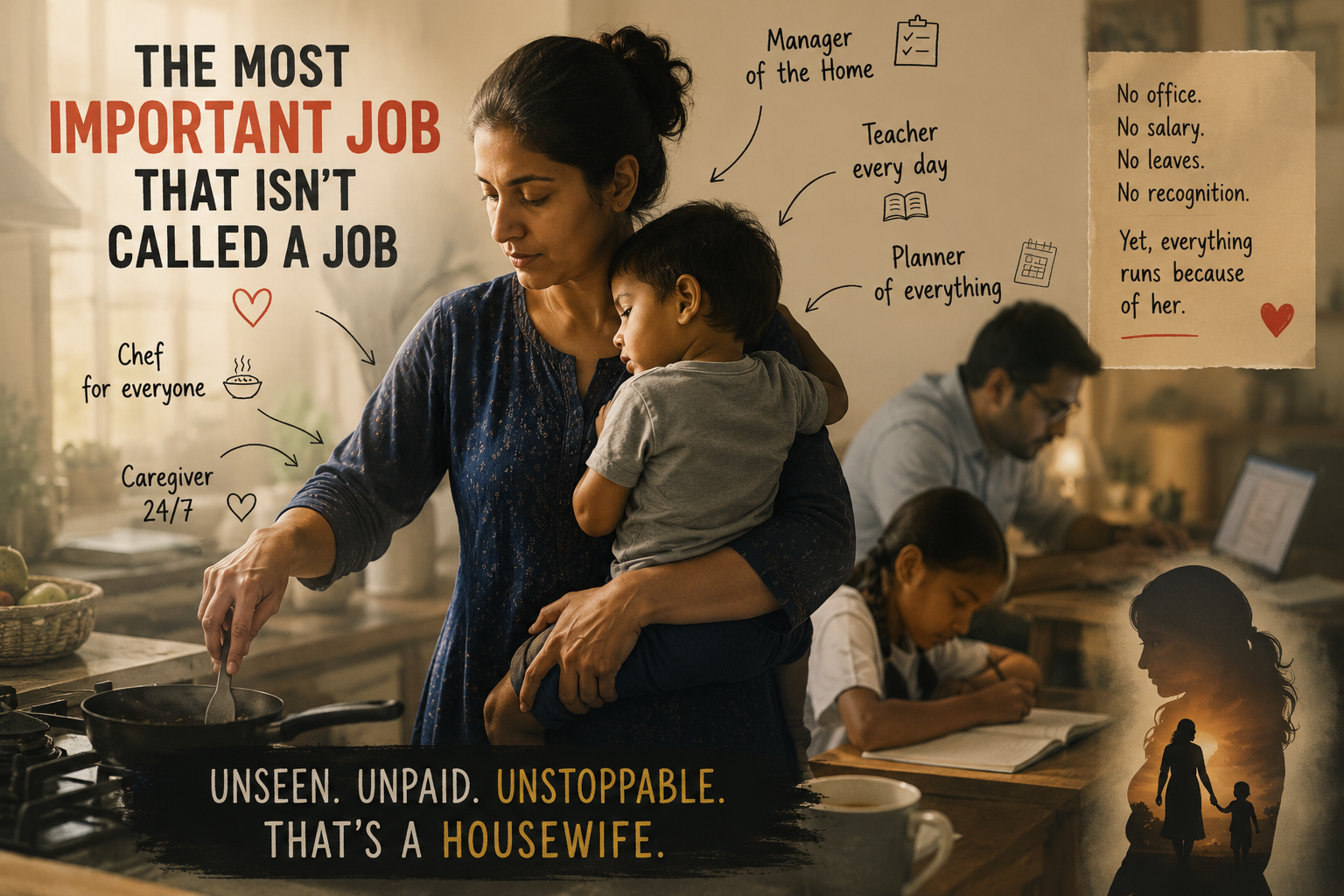
A housewife wakes up before everyone else and often sleeps last. Her day is not defined by working hours but by responsibilities that stretch endlessly. From ensuring that meals are prepared on time to managing household expenses efficiently, she plays the role of a manager, a caretaker, a planner, and what not. There is something quietly powerful about a housewife that often goes unnoticed. Her job does not come with deadlines or office hours, yet it never truly ends. She is the manager of the home, the architect of family well-being, and the invisible force behind a functioning society.
I never really understood the value of a housewife’s work until I started noticing the small things at home. Growing up, everything just felt normal. Food was always ready, clothes were always clean, and the house somehow stayed organized without anyone talking about it. But the day my mother wasn’t well and had to rest, the entire system of the house felt like it had collapsed. That was the first time I realized that what she does every day is not simple at all. It is constant effort that we often fail to see.
This is not just my story. It is the story of almost every household, especially in India. Mothers or housewives quietly manage everything without ever calling it “job”. And that is where the problem begins. The job of a housewife is probably the most underpaid and unrecognised job in the world.
In fact, it is not even considered a job by many people. There is no salary, no appreciation, and no break. But the amount of effort that goes into it is something most of us would struggle to handle for even a few days. Her work may not have a price tag, but that does not mean it has no value.
The Real Decision-Maker in the Market
Housewives are among the largest consumers and decision-makers in the market. Companies spend millions on understanding consumer behaviour, yet the reality is simple: many household purchasing decisions are directly or indirectly influenced by women. I have personally seen this in my own surroundings. The way a mother remembers everything about the house is honestly unbelievable. She knows what is running out in the kitchen, what needs repair, what the children like to eat, what the guests might prefer, and even what should be saved for future expenses. It is like she is running a small company without ever calling it one.
A woman purchases household goods not limited to food items, but from choosing groceries and daily use items as simple as a scrub to selecting furniture, electronics, and even financial investments; her preferences shape demand patterns in the economy. Every product that enters the house in some way passes through her decision. Sometimes she decides directly, sometimes indirectly by influencing others. But the final outcome often reflects her choice. She acts as a gatekeeper, filtering what enters the household and what doesn’t. If you think about it, this makes her one of the most important decision-makers in the consumer market.
Companies Target – Women
Women are ultimately the largest consumers in the market. And in an Indian market where culture is upheld by women, where it’s the wifely duty to ensure all goods are stocked in the house & family members can do their job without a hiccup.
Companies might show big strategies and marketing campaigns, but deep down, they know who they are trying to convince. That is why most advertisements are designed around women. From kitchen products to home appliances to daily essentials, everything is presented in a way that connects with her. This makes her one of the strongest forces in the consumer market. Women-centric advertisements are not just a trend; they are a recognition of her decision-making authority.
She may not sit in corporate boardrooms, but her decisions influence what sells and what does not. Companies may think they are selling products, but in reality, they are trying to earn her trust.
Conclusion – The Paradox of Recognition
Yet women are the most overlooked consumers of the market, and the corporates which target female consumers lack the female workforce within their company.
Despite being the backbone of both the household and a significant part of the consumer economy, housewives remain largely unrecognized. Society often fails to label their job as “real job” simply because it is unpaid. In a world that measures success in pay cheques and job titles, the role of a housewife stands as a reminder that some of the most important work is done without recognition. She may not earn a salary, but her contribution is priceless.
On one hand, companies design entire campaigns to attract women because they know how powerful their decisions are. On the other hand, society still does not give the same level of respect to the work they do at home. The same person who influences thousands of rupees worth of purchases every month is often financially dependent and unrecognised. Sometimes I feel the problem is not just about money, it is about how we define value. We respect job that earns money, but we ignore work that builds lives. A housewife may not bring a paycheck, but she creates an environment where everyone else can go out and earn, grow, and succeed.
“Her job is not just underpaid, it is priceless”
Do you think society gives enough recognition to the work of housewives? Share your thoughts on our Feedback Page and join the conversation.
